Concrete Construction Supplies
On a concrete job, you don’t get do-overs. Once the truck shows up, the clock starts running.
Pours stall out when someone forgets a key set of concrete tools, and stalling out means money wasted. Besides, wet concrete doesn’t pause the curing process while the crew scrambles around, looking for the necessary concrete tools.
Across Idaho and the broader Northwest, weather windows, truck schedules, and inspection timelines leave workers little margin for error on concrete jobs. Having the right concrete tools on hand for every project (clean, maintained, and ready to go) keeps placements moving, helps you hit specs the first time, and keeps your crew moving like a well-oiled machine.
At the end of the day, the goal is to produce the highest-quality, most durable product, and that requires the right tools. This guide will walk through the must-have concrete tools for forming, placing, consolidating, and finishing, along with a few extras to make long days in the sun a little bit easier.
Forming and Layout Tools: Setting the Stage Before You Pour
Before the first truck backs into place, your forming and layout tools will determine the progress of the entire concrete job. If the forms are crooked, elevations are off, or slopes aren’t dialed in, no amount of finishing skill or fancy concrete tools will save the slab.
Getting this stage of the pour correct will result in more time pouring and less time tearing out and starting over from scratch.
Core Forming Tools and Concrete Hand Tools
A solid forming kit usually starts with sturdy form boards, stakes, pins, and clamps, supported by everyday concrete hand tools like hammers, wrecking bars, and screw guns. Add string lines, tape measures, chalk lines, and levels/lasers to the list as well, and you have the basics for setting straight forms, checking elevations, and forming clean corners.
These may not be the flashiest concrete tools, but they’re the ones to reach for at the beginning of every job, whether you’re pouring a driveway or a shop floor for a commercial business.
Layout Accessories and Organization
It’s also a good idea to keep plenty of layout accessories close at hand. Marking paint, stakes, nails, and nail guns help your crew snap lines quickly and sort through the layout tasks before the first truck rolls up.
Keeping these tools organized, either in labeled bins, gang boxes, or a dedicated trailer compartment, means you’re not wasting valuable time searching for missing concrete hand tools while the truck is idling on the curb.
Throughout the busy season, organization alone can save you hours of lost time and plenty of stress. If your concrete
Steel-Handling Tools for Reinforced Concrete
If your concrete projects include footings, walls, or slabs with reinforcing steel, you’ll also need dedicated concrete hand tools and steel-handling tools for the forming phase. Manual or powered rebar benders and cutters, along with tying guns or tie-wire reels, will help you get the bar placed consistently and correctly.
Trying to bend reinforcement with makeshift concrete tools slows the crew down and can lead to inconsistent coverage or hooks that don’t meet spec. A few specialized concrete tools here make a huge difference in both quality and speed on every job.
Accounting for Local Conditions
Forming and layout are also where local conditions become an issue. In regions with freeze-thawing cycles, like much of Idaho and the Northwest, slopes and drainage matter as much as strength, and having the right concrete hand tools for the job matters too.
Using the right tools (laser levels to long straightedges) to verify the pitch away from structures protects your concrete form from standing water and premature damage.
A small investment in accurate concrete tools that account for the local climate can prevent costly callbacks later in the year.
Checklists, Displays, and Reducing Forgotten Tools
Lastly, think about how you organize and present these concrete hand tools and forming and layout tools to your crew. Whether you keep a laminated checklist on the inside of the trailer door or a simple whiteboard in the shop, having that clear display of what should leave the yard on each job reduces the likelihood of lost or forgotten items.
Ideally, foremen should read the list, sort through what they need for each type of concrete pour, and confirm everything is loaded. The goal, of course, is to show up on the jobsite ready to go to work, with everything needed and no last-minute runs back to the yard.
Reinforcing Steel: Cutting and Bending with the Right Tools
Any concrete job with reinforcements requires reliable steel-handling tools. Your must-have list should include manual rebar benders, bolt cutters, and simple jigs for small residential work. On larger commercial slabs and walls, heavier-duty tools and bench-mounted rebar benders help the crew shape larger bars more quickly and accurately.
Throw in some marking concrete hand tools like soapstone, tape measures, and framing squares so your crew can measure, mark, and cut with ease.
Organizing your steel station matters as much as your concrete hand tools. Sorting bundles by bar size, length, and use, then staging them close to where they’ll be placed, keeps the ball rolling in a straight and pretty line. A clean, efficient rebar area provides your crew with the luxury of tying steel, bending hooks, and double-checking spacing without climbing over piles of unused concrete materials.
Not only does this level of organization turn the reinforcing phase into a simple, repeatable process, but it also boosts morale, because everything is where it should be and in good working order.
Placement and Consolidation: Moving Concrete Where it Needs to Go
Once the forms are ready to go and the steel is tied, placement concrete tools keep the pour moving at the pace of the truck. Any bottlenecking rolls over into the finishing process, joint cutting, and curing, so having the right concrete tools ready to go is a must.
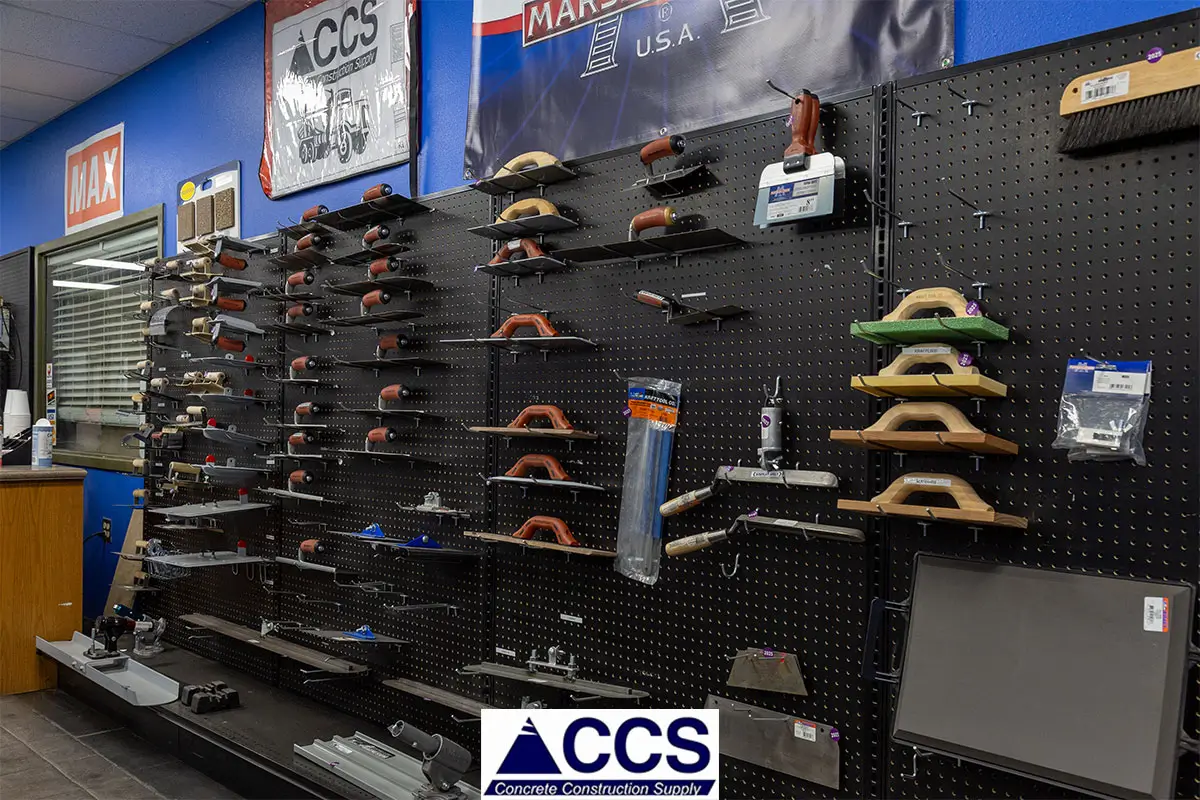
Simple gear still does most of the heavy lifting, like wheelbarrows or buggies, shovels, and come-alongs; basic concrete hand tools, but essential for moving concrete into corners and along the forms. On larger jobs, line pumps, boom pumps, and chute extensions are highly important pieces of your concrete placement tools, especially when working in tight access areas and around existing structures or sloped sites.
Once the concrete is in place, consolidation is the next priority. Internal vibrators, external vibrators, and tamping bars are key concrete tools used in concrete construction to remove entrapped air, reduce voids, and help the mix flow around reinforcement. Used correctly, these concrete tools improve strength and surface quality.
Finishing Gear: The Concrete Hand Tools Every Crew Needs
The best placement and mix can still look bad without the right concrete finishing tools in experienced hands. This is the part of the job most owners and GCs actually see, so the concrete hand tools you choose are very important.
Your core finishing kit should include bull floats, hand floats, magnesium and steel trowels, edgers, groovers, and jointing tools. These are the bread-and-butter concrete hand tools that every contractor uses to bring paste to the surface, close it up, and create clean edges and control joints.
The type and condition of your concrete finishing tools directly impact the final look and performance. A smooth garage slab, a broom-finished sidewalk, and a stamped patio each need a slightly different mix of concrete hand tools, from brooms and texture maps to specialized trowel blades.
Timing is critical as well. Knowing when to start bull floating, when to edge and groove, and when to bring out the steel trowels depends on the mix, weather, and slab thickness. Experienced finishers use their concrete tools like gauges, testing the surface, watching it bleed water, and adjusting passes as conditions change.
Safety, Cleanup, and Tool Care
It’s really easy to get caught up in only the concrete tools that touch the slab, but the safety, cleanup, and maintenance side of the job matters as well.
PPE and safety equipment, like safety glasses, gloves, respirators, and high-visibility vests, aren’t exactly concrete hand tools, but they’re essential nevertheless. In fact, data from the Bureau of Labor Statistics shows that consistent use of PPE can reduce injuries up to 60%, an excellent reason to stockpile PPE before hitting the job site.
Wash out areas, pressure washers, and cleaning brushes are often overlooked concrete tools used in construction that help you clean forms, floats, and trowels before the mud sets up. Always maintain a dedicated set of concrete cleanup tools in the truck to protect your investments and keep your job sites and work vehicles looking professional.
When labor is tight, showing that you can run a safe, well-organized operation makes a difference in attracting and retaining good workers. Regular inspections and maintenance routines should round out your support-level toolkit. Assign someone to check cords, blades, handles, and guards at the end of each workday to avoid major failures down the road.
Over time, attention to detail extends the life of your concrete hand tools, along with all the other tools your crew relies on. A little time and care in the yard, and creating a concrete construction safety checklist, means fewer breakdowns and more productive hours on the job site.
Where to Get Reliable Concrete Tools in Idaho and the Northwest
Even the best crews can’t perform without a reliable source for concrete tools and replacement parts. When you’re working across cities like Boise, Meridian, or Twin Falls, it helps to have a supplier that understands the ins and outs of local projects, the local weather, and schedules.
Concrete Construction Supply is built around the concrete construction tools and equipment contractors use every day, from forms and concrete hand tools to power tools, safety gear, and concrete accessories. Our branches and online display make it easy to sort through brands, compare options, and grab last-minute tools before heading to the job.
Whether you’re outfitting a new crew or replacing worn-out concrete hand tools, partnering with a local, contractor-focused supplier keeps the work moving instead of waiting on shipments.
Check out our products page, then contact Concrete Construction Supply to make sure your concrete tools are ready for the next pour.
FAQs
What are the most important concrete tools for small, residential jobs?
For small, residential jobs, the most important concrete tools are forming tools (stakes, forms, clamps), placement tools (shovels, come-alongs), and concrete finishing tools (floats, trowels, edgers, and brooms).
How often should concrete tools be replaced?
It depends on how often you work and the conditions, but tools that show visible wear, like rounded edges, cracked handles, and bent stakes, should be replaced before they impact finish quality. Power concrete construction tools and equipment should be inspected regularly and cords swapped as soon as they become unsafe or unreliable.
Can I rent concrete construction tools instead of buying them?
Yes, for occasional or specialized work, renting larger concrete construction tools and equipment like power trowels, vibratory screeds, or pumps can be more cost-effective than owning.
What’s the best way to store concrete tools between jobs?
Store clean, dry concrete tools in a dedicated trailer, gang box, or storage area to prevent rust and damage. Keeping form hardware, concrete finishing tools, layout gear, and other tools used in concrete construction organized by type makes it faster to load out for the next job.
Top 7 Biggest Challenges When Building a Commercial Complex
Must-Have Tools for Any Concrete Job

What Is a Formwork Rental Service? Why Contractors Use It for Concrete Projects

Introducing MST-Bar: 5 Reasons to Use MST-Bar for Concrete Reinforcement

MST-BAR® Fiberglass Rebar: The Future of Reinforcement in ICF Construction
Share
Recent Posts
March 11, 2026
Top 7 Biggest Challenges When Building a Commercial Complex
A commercial building looks fairly straightforward on a site plan. A few boxes here, offices, retail space, perhaps a shopping center anchor. But...
March 5, 2026
Must-Have Tools for Any Concrete Job
On a concrete job, you don’t get do-overs. Once the truck shows up, the clock starts running. Pours stall out when someone forgets...
February 26, 2026
What Is a Formwork Rental Service? Why Contractors Use It for Concrete Projects
Concrete construction depends on precision long before the first pour begins. Slabs, walls, columns, and foundations all require a system that defines shape,...

