
Tilt Wall Construction
Key Takeaways:
- Tilt wall panels shorten the overall construction timeline on large projects.
- Tilt wall construction reduces labor compared to traditional wood forms.
- Casting concrete panels on the slab improves quality, safety, and precision.
- Tilt-up construction is cost-effective for many commercial building types.
- Tilt-wall buildings offer durable performance and strong energy efficiency.
- Proper tilt wall bracing and hardware help keep panel erection safe and efficient.
On large commercial job sites, every day that’s lost takes a toll on the budget. For contractors and developers managing warehouses, distribution centers, and other large-scale facilities, tilt-wall panels offer a way to accelerate construction time without sacrificing safety or the quality of the product.
Compared with traditional construction methods that rely on wood forms, masonry, and multiple passes around a building, modern tilt-up construction involves more work on the slab, reduces labor-intensive steps, and makes it easier to coordinate crews, cranes, and trades.
For owners, that means faster delivery and better cost control; a win-win in all respects. For contractors, it boils down to a proven method for delivering durable, high-quality concrete walls at scale.
What Makes Tilt-Wall Construction Different?
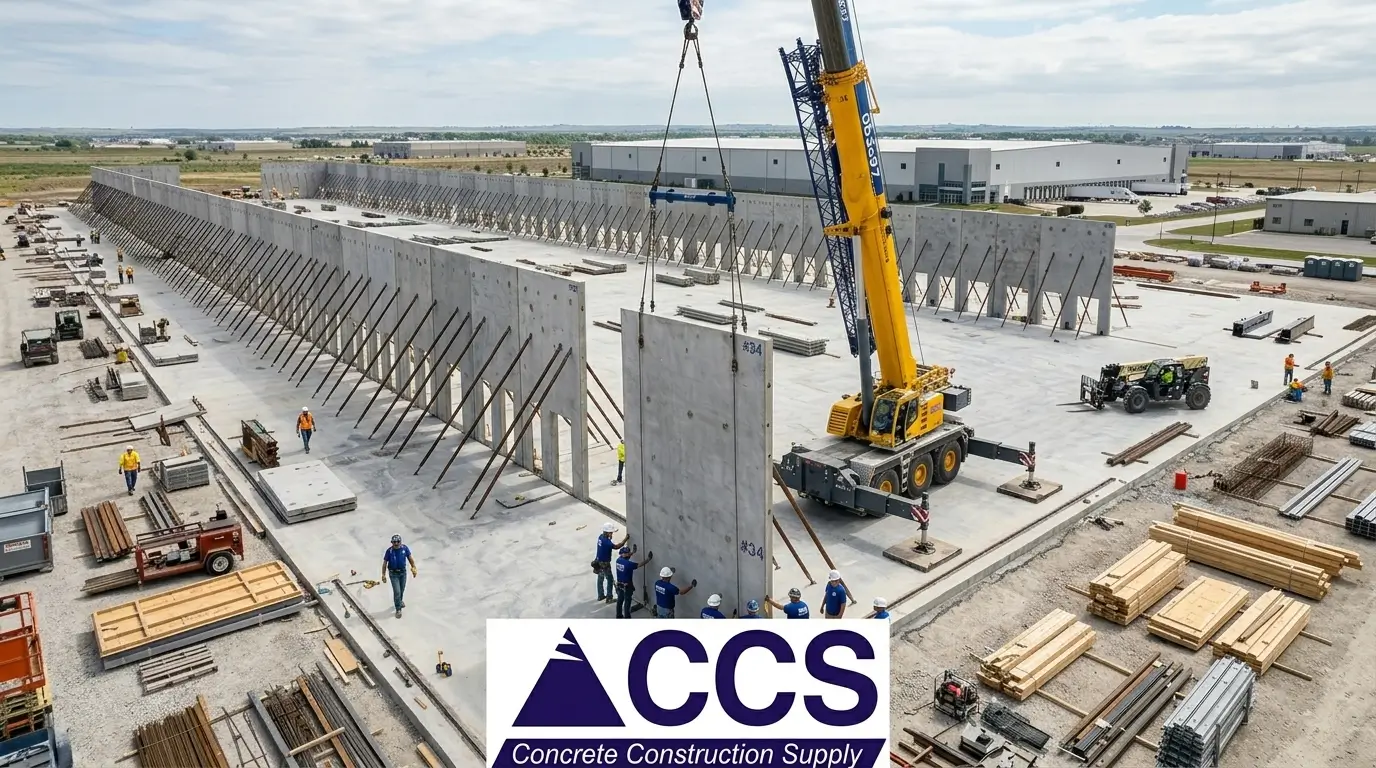
At a basic level, tilt-wall construction is a method where concrete panels are cast on-site, cured on the building’s slab, and then lifted into their final, vertical position using cranes and bracing. The building’s walls are literally formed on the ground, then tilted up to become the exterior and sometimes interior structural elements.
This construction process separates panel fabrication from panel erection. Crews first prepare the slab, layout, and rebar. Then they install the embeds, weld plates, and lifting hardware. Finally, they place the concrete while the panels are still lying flat.
After the panels cure and reach the required strength, a crane lifts each tilt wall panel into place, where it is braced, aligned, and connected to the roof and floor structure. The result is a tilted concrete shell erected in days instead of weeks.
Faster Construction Timelines on Large Sites
On large construction projects, speed is one of tilt wall’s biggest advantages. Because panels are cast horizontally on the slab, crews can pour walls and complete other work while it cures.
You’re no longer waiting for traditional construction methods like masonry lifts or complex multi-trade wall assemblies to wrap the building.
Once the panels reach the desired strength, the panel erection phase can transform a jobsite in a matter of days. A coordinated crane crew can raise dozens of tilt-up panels in a short period, enclosing the structure so follow-up trades can get started sooner.
The shorter overall construction timeline is a major reason tilt-wall construction has become a preferred method for modern commercial buildings and distribution facilities.
Reduced Labor and Reliance on Wood Forms
Traditional wall construction typically calls for wood forms, repeated form moves, and substantial, skilled labor to shape and brace each segment of the wall. Tilt wall strategies reduce that effort by using the building’s slab as the primary form surface and by repeating a limited set of form details across multiple panels.
Because the panels are assembled and poured on a flat surface, many tasks, like rebar placement, embed installation, and edge forming, are more ergonomic and efficient for workers.
Crews spend less time climbing scaffolds or working from lifts and more time performing precise work at ground level. This, of course, results in lower labor costs, fewer field variables, and a more predictable staffing plan for large tilt wall construction projects.
Improved Quality, Safety, and Precision
Casting concrete walls on the ground offers better access and visibility as well. Crews can check the dimensions, edge details, and openings with greater degrees of precision before the panels are lifted.
This reduces rework and makes sure that the door, window, and mechanical penetrations line up with the roof and interior build-out.
Safety also improves when much of the work is taking place at ground level. Workers spend more time on solid ground, and the crane-assisted erecting process follows a consistent sequence using engineered lifting inserts and braces.
With the right rigging and tilt-wall bracing equipment, contractors can manage risk during the critical lift and placement operations while maintaining schedule efficiency.
To support this phase, Concrete Construction Supply provides specialized bracing systems and hardware throughout Idaho and the Northwest region, designed specifically for tilt-wall buildings.
Cost Effectiveness and Material Efficiency
Tilt wall construction delivers strong cost effectiveness on large projects because it combines structural and architectural functions into a single system. The building’s walls act as both structure and exterior skin, reducing the need for additional framing and cladding layers that are common in other methods.
That makes tilt wall a cost-effective choice for many building types where speed and durability matter.
Using the slab as the casting surface also reduces the amount of temporary materials needed on site. Instead of building and stripping formwork for every lift, contractors reuse a limited set of edge forms and chamfers.
This efficient use of materials, combined with faster schedules and lower labor demands, helps keep the total cost under control, without sacrificing quality or durability.
Design Flexibility and Performance
While early tilt-wall buildings were known mainly for big-box footprints, modern tilt-up construction supports a wide range of construction types and architectural features. Panels can be shaped, insulated, and detailed to deliver unique facades while still benefiting from the inherent durable nature of concrete.
From a performance standpoint, tilt wall structures offer excellent thermal mass and strong fire resistance. Their energy efficiency can contribute to lower operating costs compared to lighter wall systems.
This is especially true in climates where temperature swings are significant. When you combine design flexibility with long-term performance, the key benefits of tilt wall extend well beyond the initial construction phase.
Better Use of Equipment, Crews, and Site Logistics
On busy jobsites, coordinating trades, deliveries, and equipment is often just as challenging as the work itself. Tilt wall methods simplify that coordination by organizing work around a clear sequence: slab prep, panel casting, crane erection, and roof framing.
Because panels are cast on site and raised from the ground, there’s no need to transport large wall elements from an off-site plant, which reduces trucking complexity and staging demands.
A single crane can handle panel lifting, roof steel placement, and other heavy picks within the same mobilization. It’s a streamlined process that helps contractors maintain speed, minimizes downtime, and keeps workers focused on high-value tasks instead of setups that are constantly shifting around.
Why Tilt Wall Strategies Fit Large-Scale Commercial Buildings
For warehouses, manufacturing facilities, and other large buildings, tilt wall construction supports project goals, especially those aiming for speed and efficiency with zero quality loss. These construction projects typically require:
- Long, uninterrupted spans of walls.
- Robust structure capable of handling high wind, seismic, and loading demands.
- A predictable method that can repeat across multiple buildings or phases.
By using repeated tilt wall panels and standardized details, contractors can replicate a proven method across sites and regions.
As more crews gain experience with tilt-up, the advantages in efficiency, schedule, and cost become more pronounced, making tilt-up the perfect solution for large commercial buildings throughout Idaho, the Northwest, and beyond.
Putting Tilt Wall Panels to Work on Your Next Project
For contractors, builders, and developers looking to streamline big jobs, tilt wall panels offer a powerful combination of speed, efficiency, and long-term performance. By casting panels poured on the slab and tilted into place, you can shorten the overall construction timeline, reduce dependence on labor-intensive forming, and deliver a durable structure that meets modern design and energy expectations.
At Concrete Construction Supply, we support tilt wall construction across Idaho and the surrounding region with the braces, hardware, and field support contractors need to keep projects moving.If you’re planning a new facility or evaluating tilt-up construction for upcoming construction projects, visit our tilt-wall bracing equipment page to explore available systems and options. Then connect with our team to discuss your next project, review tilt-wall systems and options, and outfit your crew with the equipment that helps you build faster, safer, and more cost-effectively.
How Tilt Wall Panels Improve Efficiency and Reduce Labor in Large-Scale Projects?

Stamped vs Decorative Concrete: What’s the Difference?

What Is the Role of Prefabricated Rebar Cages in Modern High-Rise Construction
How Tilt-Up Construction Works and What Makes it a Popular Choice in a Commercial Building
A Comparison of MST-BAR Fiberglass vs Traditional Steel Rebar
Share
Recent Posts
May 3, 2026
How Tilt Wall Panels Improve Efficiency and Reduce Labor in Large-Scale Projects?
Key Takeaways: On large commercial job sites, every day that’s lost takes a toll on the budget. For contractors and developers managing warehouses,...
April 22, 2026
Stamped vs Decorative Concrete: What’s the Difference?
Key Takeaways: In a one-on-one comparison of stamped vs decorative concrete, “scope” is the biggest difference. Keep in mind that stamped concrete is...
April 18, 2026
What Is the Role of Prefabricated Rebar Cages in Modern High-Rise Construction
Key Takeaways: What if one decision could shave weeks off your high-rise timeline, without sacrificing structural integrity? Prefabricated rebar cages play a central...

