
Concrete Forms
Key Takeaways:
- Plywood and timber formwork remain practical and cost-effective for custom or one-off pours.
- Steel and aluminum formwork offer superior durability and high reuse value for large-scale projects.
- Plastic and modular systems provide rapid assembly and lightweight handling for slabs and standard structural pours.
- Insulating concrete forms (ICFs) serve as a permanent formwork that stays in place after the pour.
- The right formwork choice depends on your project type, reuse requirements, surface finish expectations, and labor capacity.
- Concrete Construction Supply stocks and supports formwork for contractors throughout Idaho and the Northwest.
Choosing the wrong formwork can easily slow your project to a crawl. A bad choice can compromise structural integrity, inflate your labor costs, and leave your crew dealing with issues that should never have existed in the first place.
If you’re pouring walls in Treasure Valley, setting slab formwork on a commercial build in the Northwest, or working through a tight residential foundation schedule, you need to choose the right concrete formwork for the job.
Choosing the wrong concrete formwork could easily double a project’s budget thanks to wasted materials, structural blowouts, and complete rework, often adding between $1,850 to $3,100 to the cost for a repour.
The construction industry offers more formwork options than ever before, and each comes with its own set of tradeoffs. This guide will break down the most common types of concrete formwork by material, application, and best use cases, so you can make the smart choice before the first truck rolls in.
Understanding Concrete Formwork and Why the Choice Matters
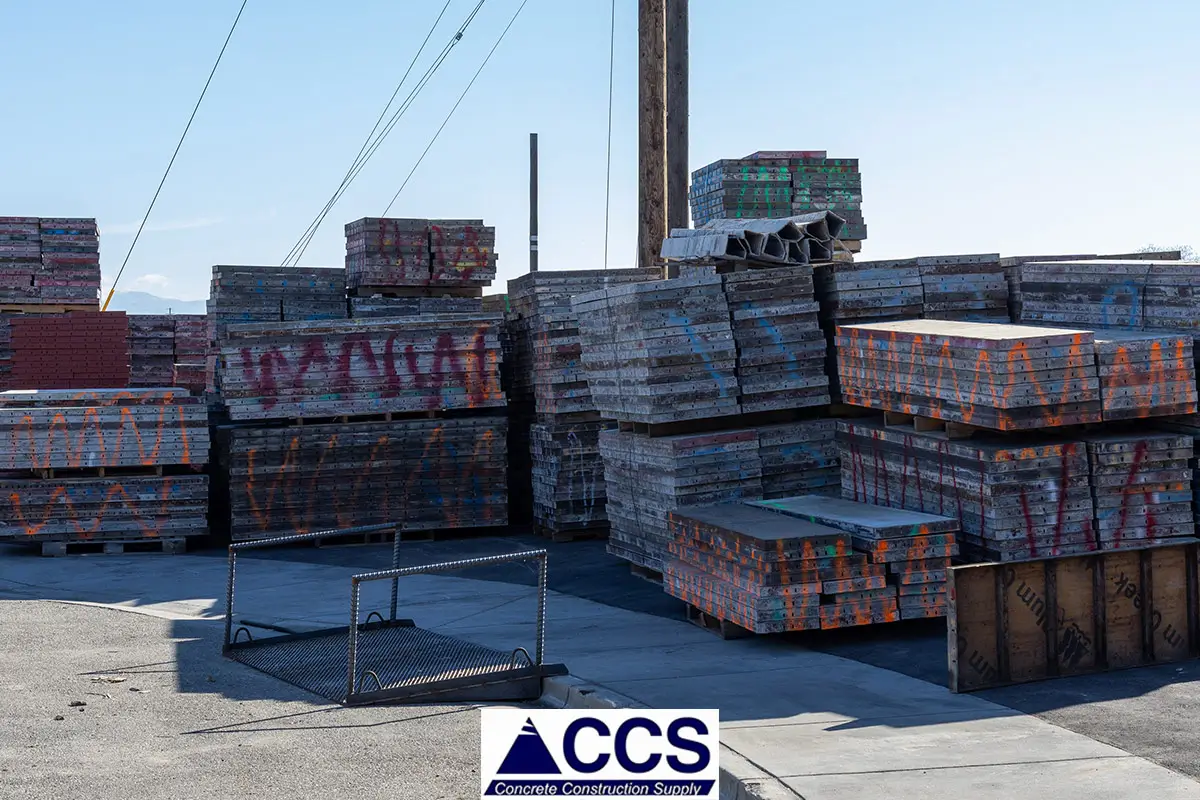
Concrete formwork consists of temporary or permanent molds that hold fresh concrete in place while it cures and reaches its design strength. Every concrete structure (walls, slabs, columns, foundations, and beams) requires a formwork system that can withstand the hydrostatic pressure of wet concrete, maintain its dimensional accuracy, and release cleanly once the hardened concrete can support itself.
The wrong choice can easily turn into deflection under load, blowouts, poor surface finish, or excessive labor from stripping and resetting forms between pours. The right decision will reduce your construction project costs, keep your pour schedule on track, and produce clean, accurate results.
Plywood and Timber Formwork
Traditional timber formwork and plywood formwork have historically been the workhorses of concrete construction. Plywood facing mounted on timber framing is still widely used on custom residential foundations, site-cast walls, and projects where the formwork needs to be cut and fitted to irregular or complex shapes.
It’s best for custom foundations, residential walls, irregular forms, and projects where flexibility matters more than reuse cycles.
Advantages
- Easily cut, shaped, and assembled on site.
- Low initial material cost.
- Widely available from local suppliers across Idaho and the Northwest.
- Suitable for complex shapes that modular systems can’t accommodate.
Limitations
- Lower reuse value compared to steel or aluminum, typically 5 to 20 uses before degradation.
- Labor-intensive to assemble, strip, and repair between pours.
- Susceptible to moisture absorption in wet conditions, which may impact dimensional consistency.
Plywood formwork remains a reliable option for smaller crews, custom pours, and Northwest jobsites where adaptability is more valuable than high-volume repetition.
Steel Formwork
Steel formwork systems use rigid steel panels with interlocking connections to create strong, reusable molds for walls, columns, foundations, and other structural concrete elements. Steel formwork is among the most durable formwork options available, capable of withstanding hundreds of reuse cycles with proper maintenance.
It’s best for commercial buildings, foundation walls, column formwork, and large-scale projects with high pour repetition.
Advantages
- Extremely high reuse value, since steel panels can last the life of a business with proper care.
- Delivers a smooth and consistent concrete finish.
- Dimensionally stable under the pressure of large pours.
- Well-suited for modular formwork systems and climbing formwork applications in multi-story structures.
Limitations
- Higher upfront investment than timber or plywood.
- Heavy when handling and/or repositioning, requiring more labor or equipment.
- Limited flexibility for highly irregular or curved structures.
For commercial builders and foundation crews in Idaho running repetitive pours, steel formwork’s long-term economics are difficult to beat.
Aluminum Formwork
Aluminum formwork offers many of the same structural advantages of steel, but at significantly lower weights. Aluminum formwork is typically 50% lighter than steel formwork, making it easier and faster to handle, set, and strip on the jobsite.
Aluminum forms are widely used in residential subdivision construction, commercial slabs, and any application where rapid cycling between pours is a priority.
It’s best for residential tract construction, slab formwork, wall systems, and projects where cycle speed and labor efficiency are top priorities.
Advantages
- Lightweight panels reduce physical demand on crews and speed up form-setting cycles.
- High reuse value compared to steel.
- Corrosion-resistant, performing well in Northwest construction environments with seasonal moisture exposure.
- Modular systems allow for flexible configuration across different pour dimensions.
Limitations
- Higher initial cost than plywood.
- Less suitable for truly complex concrete sections or heavily curved structures compared to flexible formwork options.
Aluminum steel formwork hybrids are also available for projects that require structural strength with manageable weight.
Plastic and Modular Formwork
Plastic formwork systems use lightweight interlocking panels made from high-density polyethylene or similar materials. These systems are designed for speed. The panels click together quickly, strip cleanly, and require minimal maintenance between uses.
Modular formwork more broadly refers to any prefabricated panel system (plastic, aluminum, or steel) built around a standardized grid.
It’s best for slabs, standard wall pours, foundation crews running repetitive residential pours, and projects where assembly speed is critical.
Advantages
- Very lightweight and easy to handle without heavy equipment.
- Fast assembly reduces labor costs on repetitive pours.
- Smooth release surface produces a consistent concrete finish.
- Reusable material with low per-pour cost over time.
Limitations
- Less structural capacity than steel for very large or tall wall pours.
- Less suitable for non-standard dimensions or complex shapes.
Insulating Concrete Forms (ICFs)
Insulating concrete forms are a type of permanent insulated formwork, interlocking foam panels that remain in place after the concrete cures, providing a built-in insulation and structural wall system. ICFs are increasingly common on residential and light commercial construction across the Northwest, where energy performance standards are tightening.
They’re best for residential walls, energy-efficient construction, and projects requiring permanent insulated formwork as part of the building envelope.
Advantages
- Permanent insulated formwork eliminates stripping labor entirely.
- Provides integrated thermal and acoustic performance.
- Accepted by building codes across Idaho and the broader Northwest region.
- Supports axial and shear reinforcement within the wall system.
Limitations
- Higher per-unit cost than temporary systems.
- Requires crew familiarity with ICF construction methods.
Matching Formwork to the Application
| Application | Recommended Formwork |
| Residential foundation walls | Plywood, aluminum, or ICF |
| Slab formwork | Steel or aluminum modular systems |
| Column formwork | Aluminum, plastic modular |
| Curved or complex structures | Flexible formwork or custom timber |
| Permanent insulated walls | Insulating concrete forms (ICF) |
Get the Right Concrete Forms for Your Next Project
Selecting the right formwork from the start will protect your schedule, your budget, and the quality of every pour your crew makes. Concrete Construction Supply serves contractors across Idaho and the Northwest with a full inventory of concrete forms, formwork systems, and the expertise to help you match the right product to your specific project requirements. Contact our team today to discuss your project, request a quote, or find the formwork solution that makes your jobsite more efficient and expedient.
Why Are More Contractors Choosing MST Rebar Over Traditional Steel Rebar?
What Type of Concrete Form is Best for Walls, Slabs, and Foundations?

7 Benefits of Using Modular Concrete Forms for Faster and More Efficient Projects
How Tilt Wall Panels Improve Efficiency and Reduce Labor in Large-Scale Projects?

Stamped vs Decorative Concrete: What’s the Difference?
Share
Recent Posts
May 19, 2026
Why Are More Contractors Choosing MST Rebar Over Traditional Steel Rebar?
Key Takeaways Generally speaking, steel rebar has been the go-to option in concrete reinforcement for generations. However, being the “go-to option” doesn’t mean...
May 14, 2026
What Type of Concrete Form is Best for Walls, Slabs, and Foundations?
Key Takeaways: Choosing the wrong formwork can easily slow your project to a crawl. A bad choice can compromise structural integrity, inflate your...
May 6, 2026
7 Benefits of Using Modular Concrete Forms for Faster and More Efficient Projects
Key Takeaways: Building Smarter, Not Harder Time is money in modern construction, and delays inevitably eat into both budget and reputation. However, remaining...

